
The Family Membership Exists Everywhere. Household Economics Exist Nowhere.
Updated: Sep 30
Real growth pressure. Clear thinking. No fluff. For leaders navigating the racquet sports industry right now.
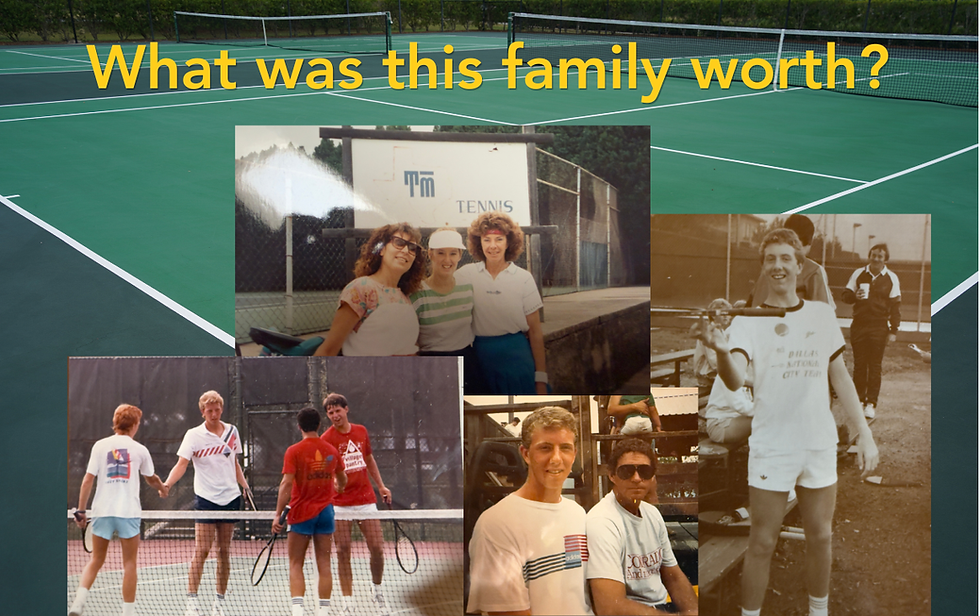
When I was growing up in Dallas, my family belonged to a tennis club called T Bar M, off LBJ Freeway in North Dallas. Indoor courts, outdoor courts, a pool, a basketball court, a small gym, and a video game room. The restaurant was nothing fancy. Burgers, chicken sandwiches, salads, sports on at the bar.
I would get there in the morning and play with my friends. My dad would come out and do drills with me even though he did not play - he was a businessman, not a tennis player. My mom was a 5.0 player. She is the reason I got into the game back in Cincinnati, at The Club at Harper's Point with Steve Contardi. In between tennis we would swim, play basketball, play video games, eat lunch, and hang around until somebody made us go home. Sunday brunch. Fourth of July events. A pro shop where you got your racquet strung and bought a can of balls.
One year, the club voted us Family of the Year.
Think about that for a second. The club knew - knew well enough to give us an award - that the thing keeping the Knowles family there was not any one of us. It was all of us. My mom's matches. My junior program. My private lessons. My dad's drills. The pool. The lunches. The whole unit.
They recognized it. They celebrated it. And I would bet everything that nobody in that building ever measured it.
That is what this issue is about.
EVERYONE SAYS COMMUNITY. NOBODY DOES THE MATH.
Community is the most overused word in racquet sports right now.
Every padel launch says it. Every club opening says it. Every conference panel ends with it. Community is the answer to retention, the answer to churn, the answer to everything. And almost nobody who says it can tell you what it means operationally - what you would price differently, program differently, or measure differently because of it.
Here is what everyone means when they say community but cannot say plainly: people stay where their people are.
And the tightest unit of "their people" walking through any club door is a family.
That is not a soft observation. It is a household economics one. And the racquet sports industry has not done the math on it.
THE INDUSTRY NEXT DOOR ALREADY FIGURED THIS OUT.
The club management world is ahead of us on this and it is worth saying so directly.
House Standard, writing about private membership clubs this March, put it plainly: family members join as a unit. They represent higher average revenue per relationship, higher stickiness, and lower churn. A family unit pays higher aggregate dues, spends more on food and beverage, and leaves at a meaningfully lower rate. They even called out CFOs for treating childcare as a cost center without netting it against reduced churn and higher lifetime value per relationship.
Private Club Marketing made the same case in June - family programming is not an amenity. It is retention infrastructure for the under-45 member whose dues tenure is still measured in decades.
The fitness industry has numbers behind it. Benchmarks citing Health & Fitness Association data - vendor-reported, so treat the precision with appropriate caution - show family plans churning at 1.4 percent monthly against 4.2 percent for individual memberships. Average tenure of 32 months against 14. Lifetime value nearly three times higher. Referral rates 1.7 times higher.
And in the private club world, full members are roughly 61 percent of the member count but generate well over 90 percent of dues and sales income once family use is included. The revenue already clusters at the household level. The industry just does not measure it that way.
None of this thinking has been imported into racquet sports. And before anyone objects - yes, every club in America offers a family membership. I am not claiming otherwise. But look at what that membership actually is: individual rates bundled at a discount. A pricing tier, not an operating model. Nobody is measuring what the household is worth. Nobody is programming for how it moves through the sports. Nobody is building retention around the unit that actually stays. Every club has the membership. Almost none of them have the economics.
THE LADDER ONLY THIS INDUSTRY HAS.
Here is what makes this specifically a racquet sports opportunity and not just borrowed country club wisdom.
At the 2025 USA Pickleball National Championships, competitors ranged from 11 to 87 years old. Sit with that. No other racquet sport - no other sport, period - puts a grandmother and a grandchild on the same court, in the same event, on day one.
That gives racquet sports something no single sport has: a progression ladder a household can climb together.
Pickleball is the entry. Zero barrier. Every age. The kid, the parents, and the grandparents can all play the first weekend. SFIA - Sports & Fitness Industry Association counted 24.3 million players in 2025, every age group growing, with more than one million new players under 18 between 2022 and 2023.
Tennis is the development path. It is where the nine-year-old who started on a pickleball court builds a competitive life. The (USTA) United States Tennis Association counts 27.3 million players, with kids 6 to 17 participation growing.
Padel is the aspiration. Younger, affluent, and an estimated 60 percent of U.S. padel players come from a tennis background. The million Americans playing padel today did not start there. They arrived there.
A household does not pick one of these sports. It moves through all three over a decade. The club that captures the household captures the entire journey - every membership, every lesson, every restrung racquet, every Sunday brunch along the way.
The club that counts individuals watches each family member churn separately and never sees the pattern.
THE HOUSEHOLD ECONOMICS GAP IS THE OPPORTUNITY.
The closest thing to household thinking in the market right now is The Bay Club Company's shared membership - up to ten people under a single membership. Their own framing: why would we care if four roommates wanted to join together? They report qualitatively that it works. They publish no household metrics.
That is the state of the art. The one operator moving instinctively in the right direction cannot tell you what it is worth.
No racquet operator publishes household lifetime value. No booking platform reports revenue per household. The metric does not exist in this industry.
That is not an oversight. That is white space.
WHAT THIS LOOKS LIKE MONDAY MORNING.
If you run a club or a multi-sport facility, here is the work.
Count households, not just members. Go into your member data and group individuals by family. You already have the addresses. Most operators have never run this report.
Measure two numbers per household: total annual revenue across every member, program, lesson, and food and beverage charge. And tenure - how long the household, not any individual in it, has been with you.
Then compare. My bet, based on every adjacent industry that has run this math: your household accounts churn at a fraction of the rate, spend multiples more, and refer more new members than any individual segment you have.
Once you see it, the decisions follow. Pricing built around the household instead of a family discount bolted onto individual rates. Programming that puts three generations on property at the same time instead of scheduling them apart. A junior pathway that is explicitly a family acquisition strategy, not a babysitting service.
The court gets one person in the door. The household model keeps all of them.
WHERE I LAND ON THIS.
The operators still standing in five years will not be the ones with the most courts or even the best community. They will be the ones who figured out that the durable revenue unit was never the individual.
The first clubs to reprice, reprogram, and measure around households will own something their competitors spend years trying to copy. Because you can copy a court. You can copy programming. You cannot copy a decade of one family's history in your building.
I know because I lived it. T Bar M kept my family for years. They gave us a trophy for it.
They never knew what we were worth.
Then a developer spent seventy million dollars renovating that property, and rebranded it Banner House at T Bar M Racquet Club. Somebody finally did the math on what the place was worth.
Nobody ever did the math on the families inside it.
HOW WE START WORKING TOGETHER.
The easiest way to work with me is the Growth Pressure Review.
Most organizations do not have a growth problem - they have a decision problem. The review helps you see where pressure is building across market position, execution, and alignment. It takes about five minutes. Your responses are analyzed personally. Not automated scoring - pattern recognition. You get a clear read on where to focus and what to stop.
That is where the work starts.
Request Your Growth Pressure Review: https://www.mikehknowles.com/review
Not ready for the review? Start with a conversation instead: Book a 30-minute conversation
mike@insidethelinesadvisory.com | 205.789.4006 | mikehknowles.com
Real growth pressure. Clear thinking. No fluff.
SOURCES
House Standard, March 2026 — Family memberships as a unit economics argument in private clubs. https://housestandard.substack.com/p/the-private-club-boom-has-a-blind
Private Club Marketing, June 2026 — Family programming as retention infrastructure. https://privateclubmarketing.com/country-club-summer-family-programming/
Rework, March 2026 (citing IHRSA 2024) — Family plan vs. individual churn, tenure, and lifetime value benchmarks. https://resources.rework.com/libraries/gym-fitness-growth/family-plans-group-memberships
SFIA 2026 Topline Participation Report — 24.3M pickleball players, age group growth, one million new players under 18 between 2022 and 2023. https://sfia.org/research/u-s-pickleball-participation/
USA Pickleball Annual Growth Report — Competitor age range 11 to 87 at the 2025 National Championships. https://usapickleball.org/about/annual-growth-report/
USTA 2026 Tennis Participation Report — 27.3M players, youth participation growth. https://www.usta.com/content/dam/usta/2026-pdfs/2026-us-tennis-participation-report.pdf
USPA — Padel surpasses one million U.S. players. https://padelusa.org/padel-surpasses-one-million-players-in-the-united-states/
PadelDrops — Estimated 60% of U.S. padel players from tennis backgrounds. https://padeldrops.com/padel-statistics
Pickleball Innovators, June 2026 — Bay Club shared membership model. https://pickleballinnovators.com/how-the-bay-club-company-is-rethinking-membership-leadership-and-the-future-of-pickleball/
City Lifestyle — Banner House at T Bar M, $70 million renovation, opened March 2025. https://citylifestyle.com/articles/reimagined-banner-house-at-t-bar-m-2
CultureMap Dallas, March 2025 — Banner House Clubhouse opening. https://dallas.culturemap.com/news/entertainment/banner-house-bar-racquet/


Comments