
Pickleball Buyers Don't Pay for Poured Concrete
Updated: 2 days ago
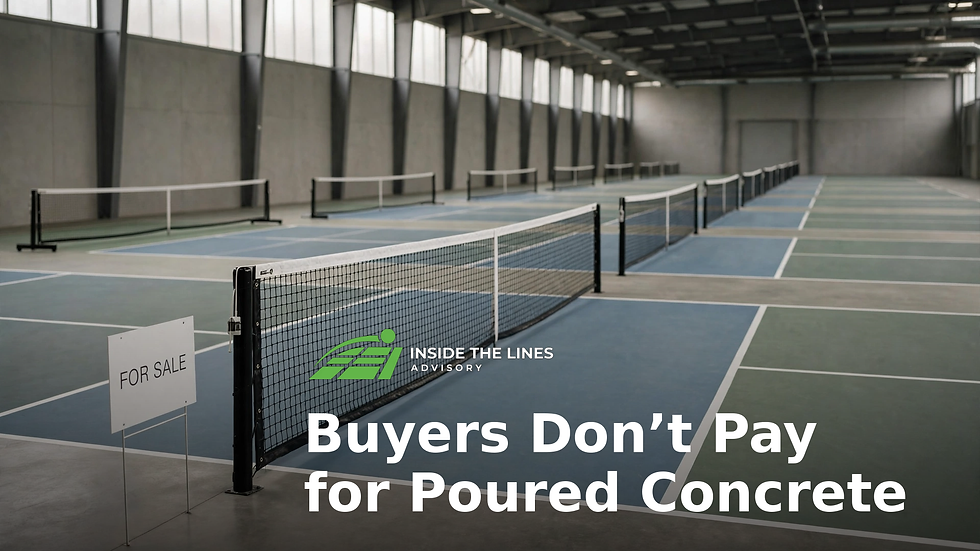
Earlier this year, a broker listed four indoor pickleball clubs at exactly $1.5 million. Florida, Maryland, Michigan, South Carolina. Four markets. One price.
That's not a valuation. That's a guess with a broker's logo on it.
In late August, the financials went public for the first time. The asks fell to $600,000, $860,000, $915,000, and $1 million.
Three signals
On September 11, The Dink reported that nine pickleball facilities listed for sale had cut their asking prices in the prior ten weeks. The typical cut was 39 percent.
To be clear, these are asking-price cuts, not completed sales. But asking prices matter. They show what happens to seller expectations once buyers get to see the books. Nine listings isn't the whole industry.
On September 17, the IAPPF reported that The Picklr, one of the country's largest indoor pickleball franchise systems, was going through a corporate restructuring.
On September 25, NJ.com reported that PickleRage's 18-court indoor club in Plainfield, New Jersey had closed less than a year after opening.
Three signals. One message.
The market is repricing pickleball facilities in real time.
It was never the building
Remember what those four listings actually were: small-business sales on BizBuySell, not real estate. The $1.5 million wasn't for a building. It was for a lease, a buildout, and a brand.
The same clubs lost a third to three-fifths of their asking price once the books were public.
It wasn't just those four. The Pickleball Academy, a five-location group across Florida, Georgia, and South Carolina, cut its ask from $4.5 million to $2.15 million. An eight-court facility with a bar on Staten Island dropped from $699,000 to $399,000.
Run the math
Now The Picklr. The company's 2026 franchise disclosure documents show 56 franchised outlets at the end of 2025. Only 12 had been open a full year. Those 12 are the system's earliest clubs, with the longest ramps.
Those 12 reported median gross sales of roughly $938,000. The disclosure gives the number that matters more: median EBITDA of 9.3 percent. That's about $87,000 in operating profit on $938,000 in sales, against a $1.25 million to $2.08 million build cost. The FDD stays quiet on whether the 7 percent royalty and 2 percent marketing fee are already out of that $87,000. Read it generously or don't. The margin is thin either way.
That's what $938,000 in sales actually buys: $87,000 a year. At that pace, a $1.25 to $2.08 million build takes 14 to 24 years to pay back, before debt service.
The results are showing it
The operating results are starting to show it. The Picklr's Round Rock club closed on September 4. In Goleta, Ted Guggenheim left the system entirely, rebranded as The Grove Pickleball, and said he was losing money under the franchise model.
The company is also restructuring. What's public so far is one former employee's post about her role ending in it. The scale beyond that is unverified.
Nobody has verified a bankruptcy filing. Restructuring is reported. Bankruptcy is rumor.
Then there is Plainfield. Eighteen indoor courts. A mezzanine, a pro shop, founder pricing. Open less than a year. Closed by September. No reason was given.
Pickleball buyers pay for earnings
So here is the uncomfortable part.
People still want to play. The demand is real. What was never real was the underwriting. These deals were priced on construction costs, not on earnings.
For three years, this industry ran on construction economics. Raise the capital. Sign the lease. Pour the courts. The valuation lived in the buildout: the square footage, the court count, the lighting, the mezzanine. "We spent $2 million building it" became a business plan.
Buyers never bought that story. They pay for earnings. A multiple of what the business actually makes. Real profit, a defensible lease, clean unit economics, members who stay. They do not pay for poured concrete.
What we're watching is the gap between what owners hoped and what buyers will pay finally closing. As David Johnson wrote in The Dink: "your facility is not worth what you spent building it."
He's right. It's worth what its next owner can reliably earn from it.
And right now, the market is forcing that distinction into the open.
None of this means pickleball is collapsing. A few price cuts, a franchisor restructuring, and one closure don't define a category. They expose the gap between a growth narrative and a business that lasts.
The category is moving from construction economics to operating economics. Pickleball is getting underwritten.
The new test
Which means the question for every operator and every board changes.
Stop asking how many courts you have. Stop reporting total visits like it's a result. Start asking what each court-hour actually contributes after rent, labor, marketing, software, and debt service. Know your revenue mix. Know your churn. Know your rent-to-revenue ratio. Know your debt-service coverage. Know what your lease actually obligates you to.
Here is the test I give every operator: show me your busiest court. Now show me its fully loaded contribution margin. If you can't, you are measuring noise, not performance.
If that test makes you uncomfortable, good. That's the point.
Wednesday, part two: padel just published its numbers. They're better than pickleball's. That's exactly the problem.
Want to know where your facility lands in the new math? I run a free Operator Scorecard with Facility Ally.
It's 26 questions, takes about three minutes, and scores the eight levers that separate facilities that make money from facilities that lose it, starting with whether you actually know your numbers.
No pitch. No obligation.
Take the Operator Scorecard: https://facilityally.com/operator-scorecard/?utm_source=mike&utm_medium=blog
Sources
The Dink, "Pickleball Facilities Are for Sale and Getting Cheaper, Fast" (Sep 11, 2026)
IAPPF, "Reports of Picklr Financial Crisis and Layoffs" (Sep 17, 2026)
NJ.com, "Popular N.J. pickleball club abruptly closes its new indoor 18-court facility" (Sep 25, 2026)
The Picklr 2026 Franchise Disclosure Document, Item 19


Comments