
Padel Is Pouring Concrete Too

Patricio Misitrano released the second annual US Padel Report this week. It's free. And if you run a facility, you should read the parts the industry will skip.
The second annual US Padel Report puts the numbers at 1,112 courts across 297 facilities in 38 states, with roughly 460,000 active players. Courts are up 61.6 percent year over year. Facilities are up 65 percent. More than half of every padel court in America was built since January 2025.
Those are real numbers, verified the hard way. Patricio calls operators. He checks websites. He cross-references announcements. Then he rebuilt the player estimate from scratch using two independent methods, court-hours utilization and federation membership benchmarks, and they landed within 2 percent of each other.
In an industry that throws around "a million players here, twenty thousand courts there" without showing its math, that's the most transparent dataset padel has. Read the headline numbers and you'll feel good. Read the rest and you'll recognize pickleball.
Patricio draws the parallel himself. I'm extending it.
Further in, the report records six facilities as temporarily or permanently closed. In two years of tracking, this is the first time the database shows clubs going dark.
The problem is what the growth is built on
Monday I wrote about pickleball facilities getting repriced in real time. Asking prices cut 39 percent. Buyers wouldn't pay for the build-out. A franchisor restructuring. An 18-court club closing less than a year after opening.
The thesis was simple:
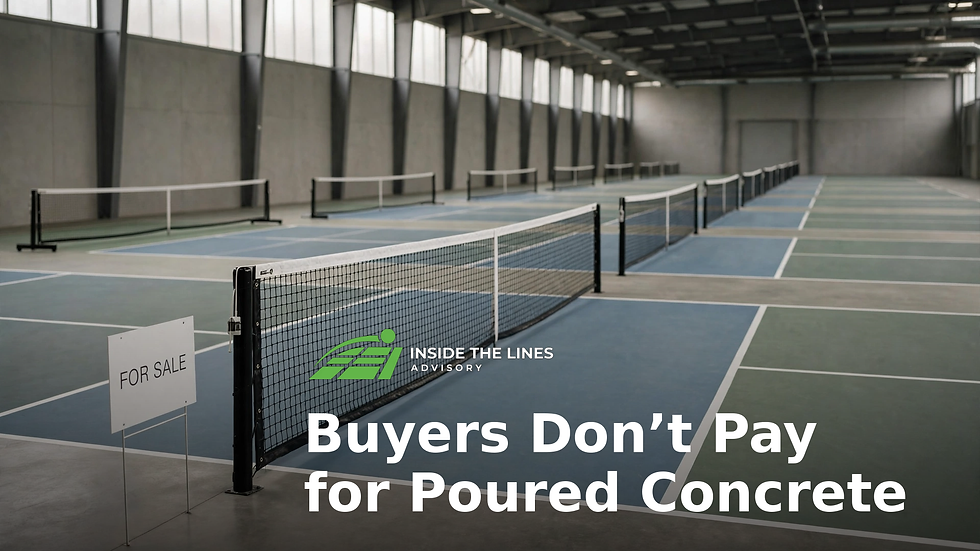
“Buyers don't pay for poured concrete. They pay for earnings.”
Padel is pouring concrete right now.
The report says it plainly. Too many operators are treating padel like a passion project or a real estate side bet rather than a real business. Capital is chasing excitement ahead of operational discipline.
And then this line, which deserves to be quoted in full:
"Growth will not be achieved by chasing positive EBITDA and an exit strategy before even beginning to operate."
That's a warning from inside the industry's own research.
The pattern matches pickleball's. The timeline is just compressed
Pickleball's shakeout took three years to arrive. Padel is showing symptoms earlier in its own cycle.
Start with the player base. Of the roughly 460,000 players, 184,000 (40%) play once a year. The report calls them infrequent players and notes they're most likely to be lost after one bad experience. A large share of that 40 percent is one bad visit from never coming back. I read that as churn risk.
Then the coaching gap. In Spain and Argentina, padel instructor certification takes four to six months and up to 285 teaching hours. In the United States, it's a two-day course with some online work. The report names junior development as the weakest link. Two findings, one problem. Certificates are being produced faster than qualified coaches.
Then the pricing paradox, which is the part operators least want to hear. Outdoor courts rent for a national median of $80 an hour per court at peak. Indoor courts run $100. Split four ways, that's $20 to $25 a player. The report says rates likely track real estate costs and market maturity.
My read: those prices reflect land and construction costs, and a price built to grow the player base would look very different. Dedicated padel clubs cannot price their way to volume. The math doesn't work.
And then Sweden. The report holds up Sweden as the cautionary tale: construction outran real demand, and the market stalled. Court supply grew more than 60 percent in the past year, faster than even Patricio's own forecast anticipated.
“Fast is not the same as sustainable.”
This is what good research does: it gives you the numbers and trusts you to draw the hard conclusions. Most of the industry will share the growth charts. Almost nobody will sit with the closures, the churn risk, the coaching gap, and the pricing math.
Where I land
Padel's infrastructure is scaling faster than its operators, its coaches, and its player pipeline. That's the same gap that opened up in pickleball. The sports are different. Pickleball clubs compete with free public courts. Padel courts cost serious money to build and to play. The mistake is the same: construction economics dressed up as business strategy.
The report's closing line belongs to Patricio: "The operators who show up with real numbers instead of good intentions are the ones who'll still be standing in five years." He's right. Six facilities. Too few to call a trend. Enough to call a preview.
What this looks like Monday morning
If you operate padel courts, or you're thinking about building them, four questions.
First: what share of your players are infrequent, and what are you doing to convert them before they churn? If you don't segment your players, you're marketing to an average that doesn't exist.
Second: who is coaching, and what are they actually certified to do? A two-day certificate is a starting point. Treat it like one.
Third: can you show the fully loaded margin on your busiest court? Same test I gave pickleball operators Monday. If you can't, you're measuring noise.
Fourth: what happens to your model when the market around you gets repriced? It happened in pickleball. Assume padel gets the same test.
That's what November is for.
SMASH 2026 is coming
I'm speaking at SMASH 2026, the International Association of Pickleball and Padel Facilities International Conference and Expo, November 17-19 at the Orange County Convention Center in Orlando, inside the Athletic Business Show. I'm also helping the IAPPF build the program. Wednesday has a session called "Pickleball and Padel Clubs That Closed and Why." It covers exactly what these two editions have been about.
Tuesday brings a dedicated Padel Business Summit. Thursday is the Global Racquet Sports Investment Summit, one full day on where the capital goes next. Three days, three tracks, 40-plus sessions for people who own, operate, develop, and invest in pickleball and padel facilities.
If you build or run these facilities, you should be in the room:
Two newsletters. Two sports. One lesson.
I wrote these two editions because I want this industry to win. Not the developers flipping facilities. The operators. The people who open the doors every morning and try to build something that lasts in a sport they love.
The opportunity here is real. I wouldn't spend my mornings writing about it if I didn't believe that. But opportunity without honest math is just expensive optimism, and I've watched too many good people learn that the hard way.
I hope these two editions help you navigate what's ahead. Read the data. Ask the hard questions before the concrete trucks arrive. Build something that earns.
But most importantly, go find your court.
Mike Knowles
Sources
Patricio Misitrano / Misitrano Consulting, US Padel Report 2026 (2nd annual; free PDF)
IAPPF, SMASH 2026 program page: https://iappf.org/the-iappf-international-conference-and-expo-2026/
Comments